 Login
Login
 Please specify the quantity of product(s).


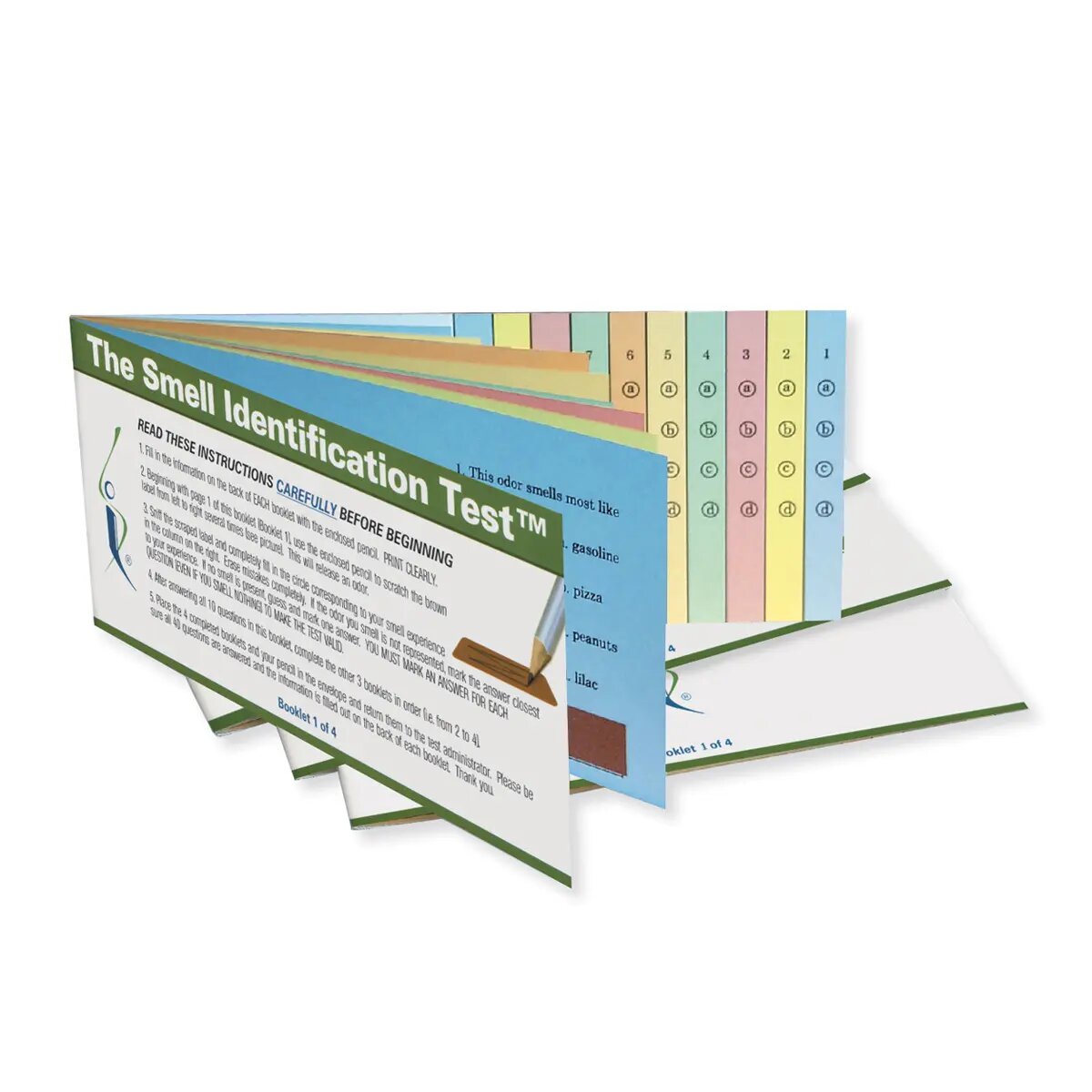


Smell Identification Test (SIT)
The Smell Identification Test (SIT) is the most widely used olfactory test, extensively normed and accurate, and provides an indication of smell loss, associated with disorders such as those involving memory loss and other sensory issues.
| Item | Product | Price | QTY |
|---|---|---|---|
| 32014 | Smell Identification Test (SIT) Kit | $75.00 | |
| 32014B | Smell Identification Test (SIT) Booklet, Pk/4 | $41.00 | |
| 32014M | Smell Identification Test (SIT) Manual | $34.00 | |
| 32015 | Brief Smell Identification Test (B-SIT) Kit | $300.00 | |
| 32015B | Brief Smell Identification Test (B-SIT) Booklet, Pk/10 | $260.00 | |
| 32015M | Brief Smell Identification Test (B-SIT) Manual | $34.00 |
 Add to Cart
The Smell Identification Test™ (SIT)
The most widely used olfactory test, extensively normed and accurate, provides an indication of smell loss, associated with disorders such as those involving memory loss and other sensory issues.
By Richard L. Doty, Ph.D.
The Smell Identification Test™ (SIT) (32014]) is a comprehensive 40-item test. It is the most reliable (test-retest r=0.94) and accurate olfactory test available and is the worldwide standard for olfactory testing.
The SIT provides an absolute indication of smell loss (anosmia; mild, moderate, or severe microsomia) as well as an index to detect malingering. Norms from nearly 4,000 men and women spanning the entire age range provide a basis for examinee percentile rank. It is available in 28 languages.
The Smell Identification Test™ (SIT) is the most widely used olfactory test, having been administered to nearly 1,000,000 people worldwide. It is easily self-administered in 10-15 minutes. Developed at the University of Pennsylvania with funding from the National Institutes of Health, the SIT is comprised of 4 booklets, each containing 10 microencapsulated (scratch & sniff) odors. Forced-choice response alternatives accompany each test item. Hundreds of publications have used this test in academic, industrial, and clinical settings.
Brief Version Available
The Brief Smell Identification Test (B-SIT [32015]) is a shorter version of the SIT. It has 12 scents, allowing for more rapid assessment, and is particularly useful for screening, yet still retains strong psychometric properties, demonstrating its accuracy and validity for assessment of individuals' smell and accompanying issues with that sense.
Why test for sense of taste of and sense of smell?
- Quality of Life
- Personal Safety
- Health
- Nutrition
- Occupational Safety
- Early Intervention
The senses of smell and taste monitor the intake into the body of all nutrients and airborne chemicals required for life. These senses provide a warning for toxic fumes, smoke, leaking natural gas, spoiled food, and dangerous environments. Importantly, they determine the flavor and palatability of foods and beverages, and provide a vast array of aesthetic delights.
Unlike vision and hearing, smell and taste testing are not routinely performed by physicians, the government, the school system, or employers. This is in spite of the fact that decreased chemosensation, particularly smell loss, can be very debilitating, placing an individual, as well as coworkers, at risk in many occupations (e.g., chemical manufacturing, nuclear plant maintenance, firefighting, police work, plumbing, aviation, nautical engineering and maintenance, and many military and industrial situations). Those who work in hazardous environments or in situations where smell warning is essential should be evaluated regularly. Such testing can be employed to transfer people with dysfunction to jobs in which decreased smell function has no major safety consequences. Smell loss can be an early sign of some diseases.
Recent research suggests Smell Tests have been found to be more effective than other measures, including temperature checks, in detecting Covid-19
Frequently Asked Questions
If I purchase the SIT Booklets (1 unit of 32014B), how many times can the SIT be administered?
Only once with one individual. 1 unit of 32014B SIT Booklets contains the 4 booklets that each contain 10 microencapsulated (scratch & sniff) odors for one test administration with one individual.
How many times can the microencapsulated odor smell tests be used?
The SIT employs microencapsulated ("scratch and sniff") odors that are meant to be used only once with one individual.
How should the smell tests be stored and do they expire?
The tests should be kept in a cool, dry area, outside of direct sunlight, at an average room temperature not to exceed 70° Fahrenheit or 21° Celsius. Stoelting ensures product quality for up to 6 months from the date of manufacture or, in the case of threshold tests, from the date of shipment.
Purchasing Options
SIT Manual (32014M) provides detailed instructions for the valid administration, scoring, and interpretation of the SIT. Normative data (including diagnostic categories and percentile scores for both sexes and across all ages) are based on nearly 4,000 subjects. A detailed description of the test’s development and validation is provided.
SIT Booklets (32014B) are comprised of 4 booklets, each containing 10 microencapsulated (scratch & sniff) odors, for one test administration with one individual. Each booklet can only be used once, and all four booklets are used in each administration. 1 unit of 32014B is good for 1 administration.
SIT Kit (32014) contains the SIT Manual (32014M) and four SIT Booklets for one administration (32014B). It should be ordered when first administering the test. Subsequently, clinicians can order additional units of Booklets.
B-SIT Manual (32015M) provides detailed instructions for the valid administration, scoring, and interpretation of the B-SIT. A detailed description of the test’s development and validation is provided.
B-SIT Booklets (32015B) Each unit is comprised of 1 booklet, containing 12 microencapsulated (scratch & sniff) odors, for one test administration with one individual. Each booklet can only be used once for each administration. There are 10 units in this item, which are good for 10 administrations.
B-SIT Kit (32015) contains the B-SIT Manual (32015M) and ten B-SIT Booklets for ten administrations (32014B). It should be ordered when first administering the test. Subsequently, clinicians can order additional units of Booklets.
List of Disorders for Testing Smell
INDEX TO NON-CLINICAL PAPERS USING SENSONICS' PRODUCTS
INDEX TO CLINICAL PAPERS USING SENSONICS' PRODUCTS (BY DISORDER)
- 22q11 DELETION SYNDROME
- ACQUIRED IMMUNODEFICIENCY SYNDROME (AIDS)
- AGING
- ALCOHOLISM & DRUG ABUSE (see also Korsakoff's Psychosis)
- ALLERGIES, NASAL INFLAMMATION, NASOSINUS DISEASE, POLYPOSI & UPPER RESPIRATORY INFECTIONS
- ALZHEIMER'S DISEASE
- AMYOTROPHIC LATERAL SCLEROSIS / MOTOR NEURON DISEASE
- ANAESTHESIA
- ANEURYSMS
- ANOREXIA NERVOSA
- ASPERGER'S SYNDROME
- ATAXIAS
- ATTENTION DEFICIT DISORDER
- AUTOIMMUNITY
- AUTONOMIC DISORDER
- BARDET-BIEDL
- BIPOLAR DISORDER
- BLINDNESS
- CANCER
- CATAPLEXY
- CEREBROVASCULAR DYSFUNCTION
- CHEMICAL EXPOSURE
- CHOANAL ATRESIA
- CHRONIC OBSTRUCTIVE PULMONARY DISEASE
- CHRONIC RHINOSINUSITIS
- CIGARETTE SMOKING
- CONGENITAL ANOSMIA/HYPOSMIA
- CHURG-STRAUSS SYNDROME
- CYSTIC FIBROSIS
- DEPRESSION
- DIABETES
- DOWN'S SYNDROME
- ELECTROGUSTOMETER
- EPILEPSY & TEMPORAL LOBE RESECTION / BRAIN LESIONING
- ESSENTIAL TREMOR
- FACIAL PARALYSIS
- FRONTOTEMPORAL LOBE DEGENERATION
- GUAMANIAN ALS/PD/DEMENTIA SYNDROME
- HEAD TRAUMA
- HUNTINGTON'S DISEASE
- IATROGENESIS
- INFLUENZA
- INTERNATIONAL POPULATIONS
- INTRACRANIAL
- KALLMANN'S SYNDROME
- KORSAKOFF'S PSYCHOSIS
- LARYNGECTOMY
- LEPROSY
- LIVER DISEASE
- LUBAG
- MEDICATIONS
- MIGRAINES
- MULTIPLE CHEMICAL HYPERSENSITIVITY
- MULTIPLE SCLEROSIS
- MUTATED GENES
- OBESITY
- OBSESSIVE COMPULSIVE DISORDER
- ORAL SUBMUCOUS FIBROSIS
- OROFACIAL CLEFTING (OFC)
- ORTHOSTATIC TREMOR
- PANIC DISORDER
- PARKINSON'S DISEASE
- PEDIATRIC
- POSTTRAUMATIC STRESS DISORDER
- PREGNANCY
- PROGRESSIVE SUPRANUCLEAR PALSY
- PSEUDOPARAHYPOTHYROIDISM
- PSYCHOPATHY
- REFSUM'S DISEASE
- RESTLESS LEG SYNDROME
- RHINOPLASTY
- SCHIZOPHRENIA
- SEASONAL AFFECTIVE DISORDER
- SINUS SURGERY
- SJOGREN'S SYNDROME
- SLEEP DISTURBANCES
- SPINOCEREBELLAR ATAXIA
- TONGUE DISORDERS
- TOXIC EXPOSURE
- UVULOPALATOPLASTY